



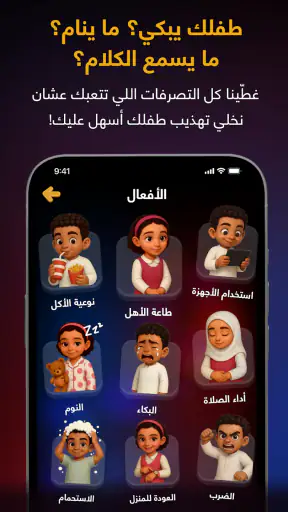

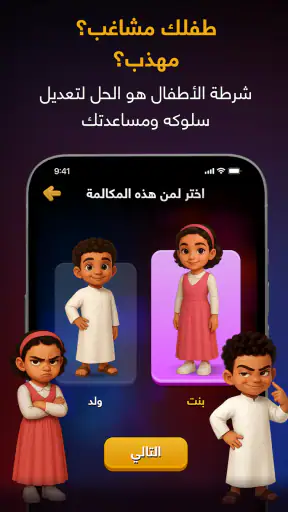
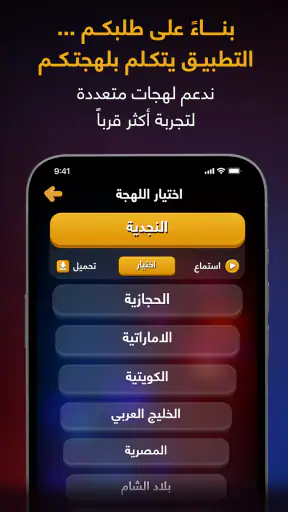
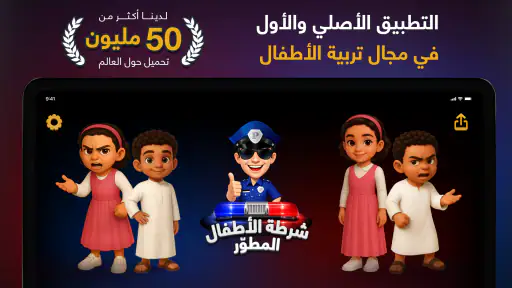
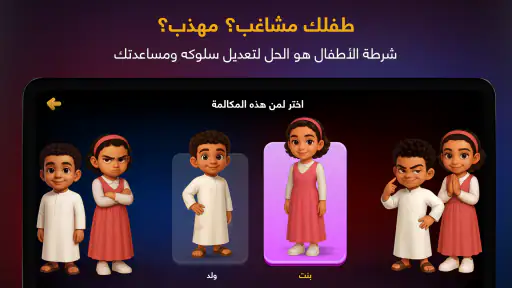
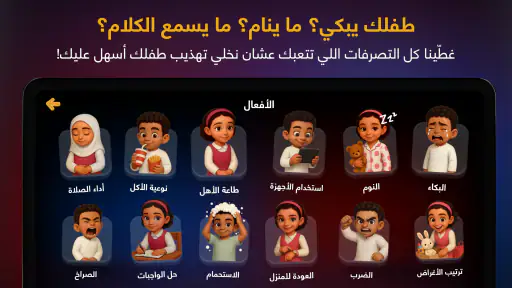
I approached شرطة الأطفال as a parenting app rather than as a conventional game. Its central idea is simple: it gives children a playful police-themed experience while offering parents a way to turn a familiar role-play concept into a short activity. That makes the first impression easy to understand, especially for families already interested in pretend play, police stories, or Arabic-language children’s entertainment.
The app is free to download, aimed at Everyone, and developed by Romman Smart Applications LLC. It belongs to the parenting category, although its presentation is clearly built around play. In my experience, that combination matters: this is not a serious parenting handbook or a structured child-development program. It is better viewed as a light, repeatable tool for shared moments between an adult and a child.
What interested me most was not whether the police theme feels exciting for a day. Most children’s apps can manage that. The more useful question is whether the idea remains welcome after the novelty wears off. With this app, the answer depends heavily on how the parent uses it. Left alone, it can become a brief novelty. Used as part of a small routine, it has a better chance of earning a regular place on the device.
How the experience develops after the first play
The first-week appeal comes from immediate role-play
The strongest part of the experience is its accessibility. A child does not need a long explanation before understanding the police theme. The concept supplies an instant pretend-play frame, and that can be useful when a parent wants to redirect attention without introducing a complicated new activity.
I found the app most suitable for short sessions rather than long stretches of passive use. A parent can introduce it as a playful “police” moment, let the child engage with the scenario, and then move on to another activity. That short format is important because children’s enthusiasm for a single theme can change quickly. The app works better when it opens a moment of interaction instead of being expected to carry an entire afternoon.
One realistic use case is a busy evening when a child needs a small distraction while an adult finishes a simple household task. Another is a parent and child playing together for a few minutes before bedtime, with the adult adding their own voice and imagination to the police scenario. In both cases, the value comes partly from the app and partly from the conversation around it.
The Arabic focus also gives it a practical place in homes where parents want children’s entertainment in Arabic rather than relying mainly on English-language alternatives. That does not automatically make it the best choice for every family, but it gives the app a clearer identity than a generic collection of mini-games would have.
During the first week, I would not judge it by how long it keeps a child occupied. I would watch whether the child asks to return to the role-play, whether the parent can join without much setup, and whether the activity ends without a struggle. Those are more meaningful signs for a parenting app than raw screen time.
Why shared play matters more than leaving it running
The police theme can be used in two very different ways. A parent can hand over the device and treat it as a self-contained distraction, or use it as a prompt for imaginative interaction. The second approach is more rewarding. Asking the child what the police character should do next, inventing a harmless situation, or letting the child take the lead can make the session feel less repetitive.
This is one of the app’s less obvious trade-offs. Its simplicity makes it easy to start, but simplicity also means the adult may need to provide some of the variety. Families looking for a highly guided educational program may find that effort inconvenient. Families comfortable with pretend play may see it as a benefit because the screen does not have to dictate every moment.
I would also set expectations carefully. The app should not be presented as a real authority or as a substitute for explaining safety, responsibility, or respectful behavior. Police-themed play can be fun, but children may interpret adult framing literally. I would keep the tone friendly and imaginative, especially with younger children, and avoid using the app as a threat or punishment tool.
What changes when the first excitement fades
After the initial curiosity, the app’s recurring value becomes more dependent on context. A child who enjoys role-play may return because the theme remains familiar. Another child may lose interest once the basic surprise disappears. That is not necessarily a flaw unique to this app; it is a common limit of narrowly themed children’s entertainment.
The practical solution is to vary the surrounding activity rather than expecting the app itself to provide endless newness. One session might involve the child acting as the officer, while another lets the parent play along. A short conversation about helping others can give the same on-screen material a different purpose. These changes cost no money and require no complicated setup, but they do require an adult to participate.
That makes the app less suitable for parents who want a large, constantly changing content library. It is more suitable for someone who values quick access, a recognizable theme, and the possibility of turning a digital prompt into offline conversation.
Month-to-month value depends on a small routine
For lasting use, I would connect the app to specific occasions instead of opening it whenever a child is bored. It could become a short weekend activity, a shared Arabic-language play session, or an occasional transition between tasks. A predictable place in the family routine gives it a reason to remain installed.
The key is moderation. If it appears every time a child complains, its novelty may disappear faster and the child may begin to expect a screen response to every moment of boredom. If it is reserved for selected situations, it can retain more of its special character. This is a parenting decision rather than a technical feature, but it strongly affects the app’s long-term usefulness.
I would also avoid measuring success by whether the child returns independently every day. For this kind of app, occasional use can still be worthwhile. A tool that works well for ten minutes during a difficult transition may deserve space even if it is not opened constantly. Recurring value does not always mean daily use; it can mean reliably fitting a particular family need.
Where it compares well with ordinary alternatives
Compared with general video apps, this experience has a clearer imaginative direction. A video may hold attention more passively, while a police-themed activity gives the parent an opening to ask questions and join the play. That said, video platforms usually offer much broader variety, so they may be better when a child wants different stories or longer viewing sessions.
Compared with educational apps, this one is less obviously structured around lessons or measurable progress. Parents seeking reading practice, numbers, language exercises, or a carefully sequenced learning path should choose a dedicated educational product instead. The advantage here is ease and theme, not academic depth.
Compared with offline police role-play using toys or costumes, the app is more convenient because it is already on a phone or tablet. Offline play is usually richer for movement, social interaction, and open-ended creativity, though it requires preparation and available space. I see this app as a bridge to that kind of play, not a replacement for it.
The maintenance burden is light, but parental guidance remains important
From a practical viewpoint, the app is easy to keep available because it is free to download and its current version is 7.15. It supports operating systems from 8.1 onward, which makes it accessible on a range of compatible devices. The app has also reached more than five million installs, and its average rating is 4.5 from roughly twenty-nine thousand ratings, suggesting that many families find the basic concept appealing.
Those figures are useful signals, but they do not remove the need for personal judgment. A popular children’s app can still be a poor fit for a particular child. I would test it during a calm moment first, check how the child responds to the theme, and decide whether it encourages interaction or simply creates another request for screen time.
There are optional in-app purchases, priced from $2.99 to $17.99 per item. That means the free entry point is helpful, but parents should pay attention before approving anything beyond the initial download. I would make the purchasing decision in advance rather than allowing a child to explore payment prompts during play. The app’s value should be judged on the free experience first, not on the assumption that extra spending will solve repetition.
Maintenance also includes managing when the app is used. A simple rule, such as playing only with an adult nearby or stopping after a short agreed session, can prevent the app from becoming a default background activity. The police theme makes adult framing especially worthwhile: I would emphasize helping, listening, and imagination rather than fear or punishment.
The main sources of fatigue
The first source of fatigue is thematic repetition. Police role-play is immediately recognizable, but a narrow theme can feel limited once the child has explored the basic idea. If your child prefers puzzles, construction, drawing, or constantly changing stories, this app may not hold attention for long.
The second is dependence on adult energy. The experience gains depth when a parent adds dialogue and imagination, but that may be difficult during a rushed day. If the app only works well when an adult actively performs alongside it, some families may find it less convenient than a self-contained game.
The third is the difference between entertainment and parenting support. The category can create an expectation of useful guidance, yet the app’s appeal is primarily playful. I would not install it expecting detailed advice about behavior, developmental milestones, or family routines. It can support a moment of interaction, but it should not carry the responsibilities of a parenting resource.
There is also a cultural and age-related consideration. The Everyone rating makes the app broadly accessible, but children within that broad group can react very differently to police imagery. Some will find it exciting; others may find authority-themed play uncomfortable or simply uninteresting. Parents should observe the child rather than assuming the rating guarantees a universal fit.
Who should keep it installed
I would recommend keeping it installed if you want a lightweight Arabic children’s app with a clear pretend-play theme, especially when you are willing to join for short sessions. It is a reasonable choice for families that prefer occasional, guided screen use over an endless feed of unrelated content.
It is also a good candidate for parents who need a quick activity with almost no preparation. The recognizable scenario can get a conversation started quickly, and the free download makes trying it relatively straightforward. The strongest fit is not the child who needs hours of content; it is the child who enjoys returning to a familiar imaginative idea.
I would skip it if your priority is a deep educational curriculum, a broad game collection, active physical play, or sophisticated long-term progression. In those situations, a dedicated learning app, an offline activity, or a more varied game will likely provide better value. I would also skip it if your child is sensitive to police or authority themes, since no amount of convenience makes an uncomfortable subject worthwhile.
My long-term verdict
After the novelty fades, شرطة الأطفال earns its place only when treated as a small shared-play tool. Its lasting strength is not unlimited content or complex progression. It is the speed with which it gives a parent and child a familiar scenario to act out in Arabic, without demanding much preparation.
That strength comes with a clear limitation: the parent supplies much of the variety. Used passively, the app may become repetitive and easy to forget. Used occasionally, with a short routine and a little imagination, it can remain useful well beyond the first week.
My recommendation is therefore positive but selective. Try the free experience, watch how your child responds, and decide whether it creates conversation rather than simply extending screen time. Keep purchases under adult control, set a simple stopping point, and use the police theme as friendly pretend play rather than discipline. For families that match that approach, the app can justify its space. For everyone else, its initial appeal may be stronger than its long-term value.
Romman Smart Applications LLC has made a focused parenting app rather than an all-purpose children’s platform. That focus is both its identity and its boundary. If you want a quick Arabic role-play activity that can become part of an occasional family routine, it is worth trying; if you need depth, variety, or structured learning, choose a different kind of app.


